
What is DLI? Why “Light Quantity” Matters More Than Brightness
If you asked a chef for a recipe and they only told you how hot the oven gets, you’d never be able to cook the meal. You need to know how long to cook it.
Growing plants is no different. In the world of horticulture lighting, it is easy to get obsessed with “brightness”—how intense a fixture is or how high the PPFD numbers spike on a meter. But plants don’t grow based on a snapshot of brightness; they grow based on the total quantity of light they accumulate over an entire day.
This is where Daily Light Integral (DLI) becomes the most critical metric for precision cultivation. At SUNSCAPE, we believe that understanding DLI is the difference between a good grower and a master cultivator.
What is Daily Light Integral (DLI)?
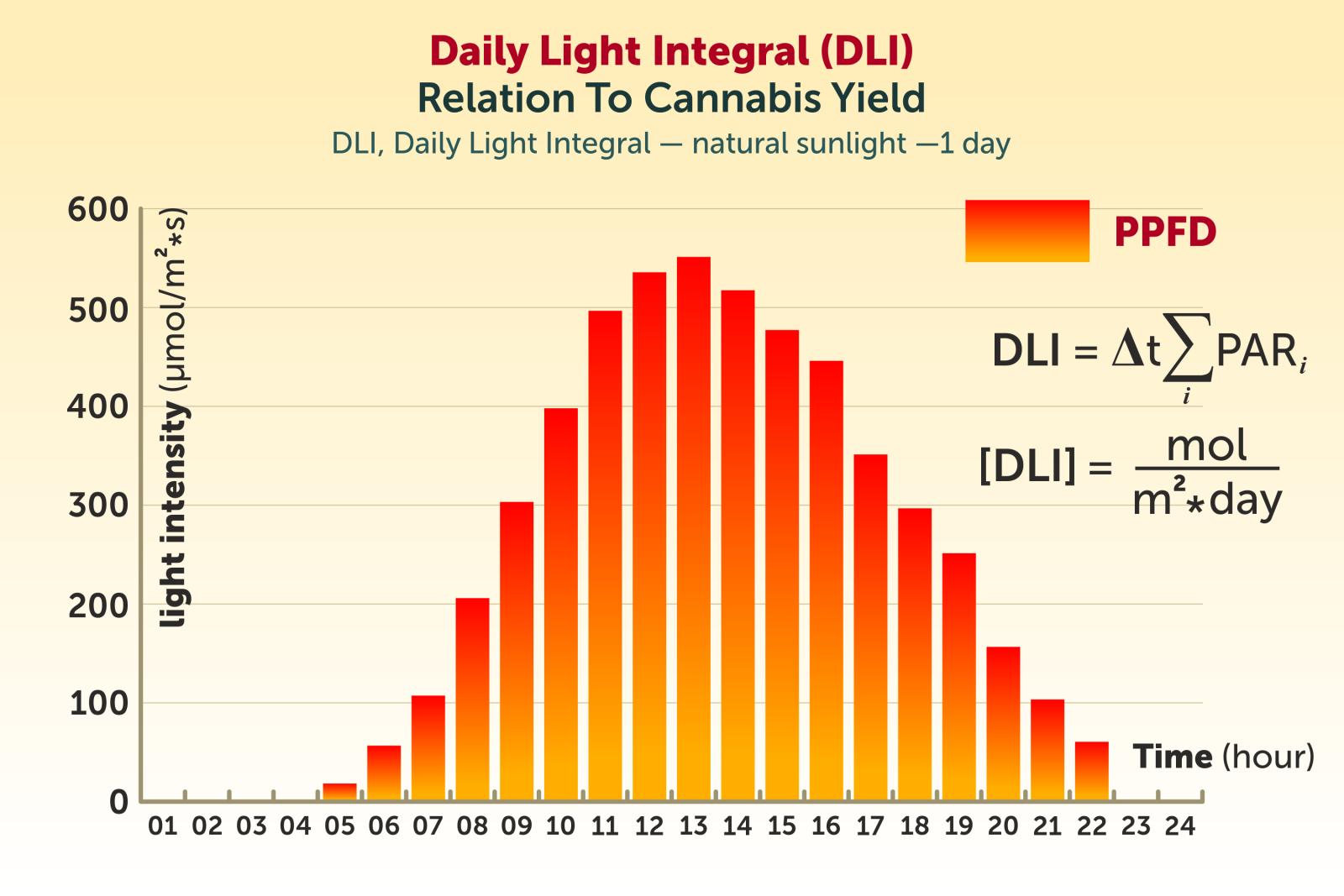
Technically, DLI is the total number of photosynthetically active radiation (PAR) photons that strike a given area over a 24-hour period. It is measured in moles of light per square meter per day (mol·m⁻²·d⁻¹).
But the best way to understand DLI is the “Rain Gauge” analogy:
Think of light particles (photons) like raindrops falling on your crop.
PAR is the type of rain (the water plants can actually drink).
PPFD is how hard the rain is falling right now (the intensity).
DLI is the total amount of water collected in the rain gauge at the end of the day.
You can fill that rain gauge by having a massive storm for 20 minutes (high intensity, short time) or a steady drizzle all day (low intensity, long time). To the plant, the total volume in the “gauge” is what matters.
The Math: Intensity vs. Time
DLI is the product of two variables: Light Intensity (PPFD) and Duration (Photoperiod).
The formula is:
DLI = (Average PPFD × Light Hours × 3600) ÷ 1,000,000
This relationship is vital because it proves that high-wattage lights aren’t always better. A system with massive intensity but poor distribution might blast the top leaves for 12 hours while leaving the edges starving. A balanced DLI approach ensures the whole canopy gets “fed.”
How Much DLI Do Your Plants Need?
Plants have an evolutionary “calorie count” for light. If you underfeed them, yields suffer. If you overfeed them, you waste electricity and risk light stress.
Leafy Greens (Lettuce/Basil): 12–17 mol/day
Tomatoes/Peppers: 20–30 mol/day
Cannabis (Flowering): 40–60 mol/day
Note: Achieving high DLI (40+) requires CO2 supplementation to allow the plant to process that much energy.
The “Indoor Advantage”
Outdoors, the sun dictates your DLI. Clouds, seasons, and the angle of the sun change the “flow rate” of light constantly. Greenhouse growers have to constantly adjust shading or supplemental lighting to hit their targets.
Indoors, you are the sun.
This makes DLI a powerful planning tool rather than just a measurement. Because SUNSCAPE LED fixtures provide stable, consistent intensity, we can engineer a lighting schedule to deliver your target DLI with mathematical precision.
The SUNSCAPE Difference: Uniformity is Key
Reaching a high DLI is easy if you just hang a powerful light directly over one plant. The challenge—and where SUNSCAPE excels—is Uniformity.
If your DLI is 50 mol/day directly under the light but only 20 mol/day at the edge of the tray, your harvest will be inconsistent. We design our optics to spread PPFD evenly across the canopy. This ensures that every plant in the room fills its “rain gauge” to the same level, giving you a standardized, predictable crop every single cycle.
The SUNSCAPE Performance Standard: Data-Backed Cultivation
Now that you understand how the quantity of light is measured, book a discovery call with SUNSCAPE to unlock SUNSCAPE performance standards. Backed by 8 years of data collection, we have established weekly and daily DLI baselines matching the 63 to 73-day flowering cycles of over 500 genetics. Let us help you optimize your harvest by matching PPFD levels, and spectrum tuning to produce the best result matching your irrigation and environmental strategies.