
CO₂ Enrichment: The “Turbo Button” You Might Be Using Wrong
In the race for higher yields, Carbon Dioxide (CO₂) is often sold as a magic shortcut. Growers pump it into their rooms expecting an instant 20% boost in weight, only to find their plants stalling, stretching, or showing mysterious deficiencies.
Here is the hard truth: CO₂ does not create growth.
CO₂ is a performance amplifier. It is the turbocharger on your engine. And just like a turbocharger, if you engage it without pressing the gas pedal (Light) or tuning the cooling system (VPD), you won’t go faster—you’ll just blow the engine.
The Biology: Why Plants “Eat” Air
Photosynthesis depends on three primary inputs: Photons (Light), Water, and Carbon Dioxide.
Think of your plant like a high-speed assembly line.
- Light provides the energy (the workers).
- CO₂ provides the raw material (the carbon bricks).
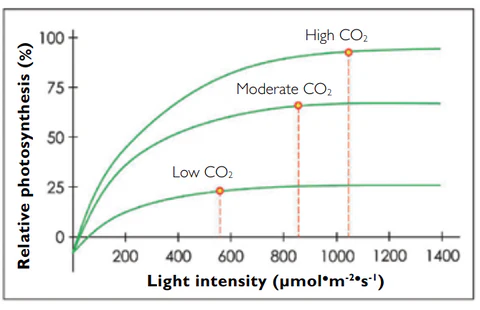
Ambient air contains about 400 ppm of CO₂. Under low light, this is plenty. The workers (Light) are moving slowly, so the pile of bricks (CO₂) never runs out.
But when you upgrade to high-intensity LEDs (pushing 1,000+ PPFD), the workers start moving effectively. Suddenly, the assembly line runs out of bricks. This is the Carbon Bottleneck. Enrichment removes this limit, filling the room with 1,000–1,200 ppm of CO₂ so the line can keep moving at maximum speed.
The “Gas Pedal” Rule: Light Comes First
One of the most expensive mistakes growers make is pumping CO₂ into a room with insufficient light intensity.
CO₂ demand scales directly with photon delivery.
- < 700 µmol/m²/s: The turbo is useless. The plant can’t process the extra carbon. You are just wasting gas.
- > 800 µmol/m²/s: The engine is revving high. The plant is now “light saturated” and needs extra CO₂ to go faster.
Never boost CO₂ until you have the PPFD (Light Quantity) to justify it.
The Hidden Traps: Why Enriched Rooms Crash
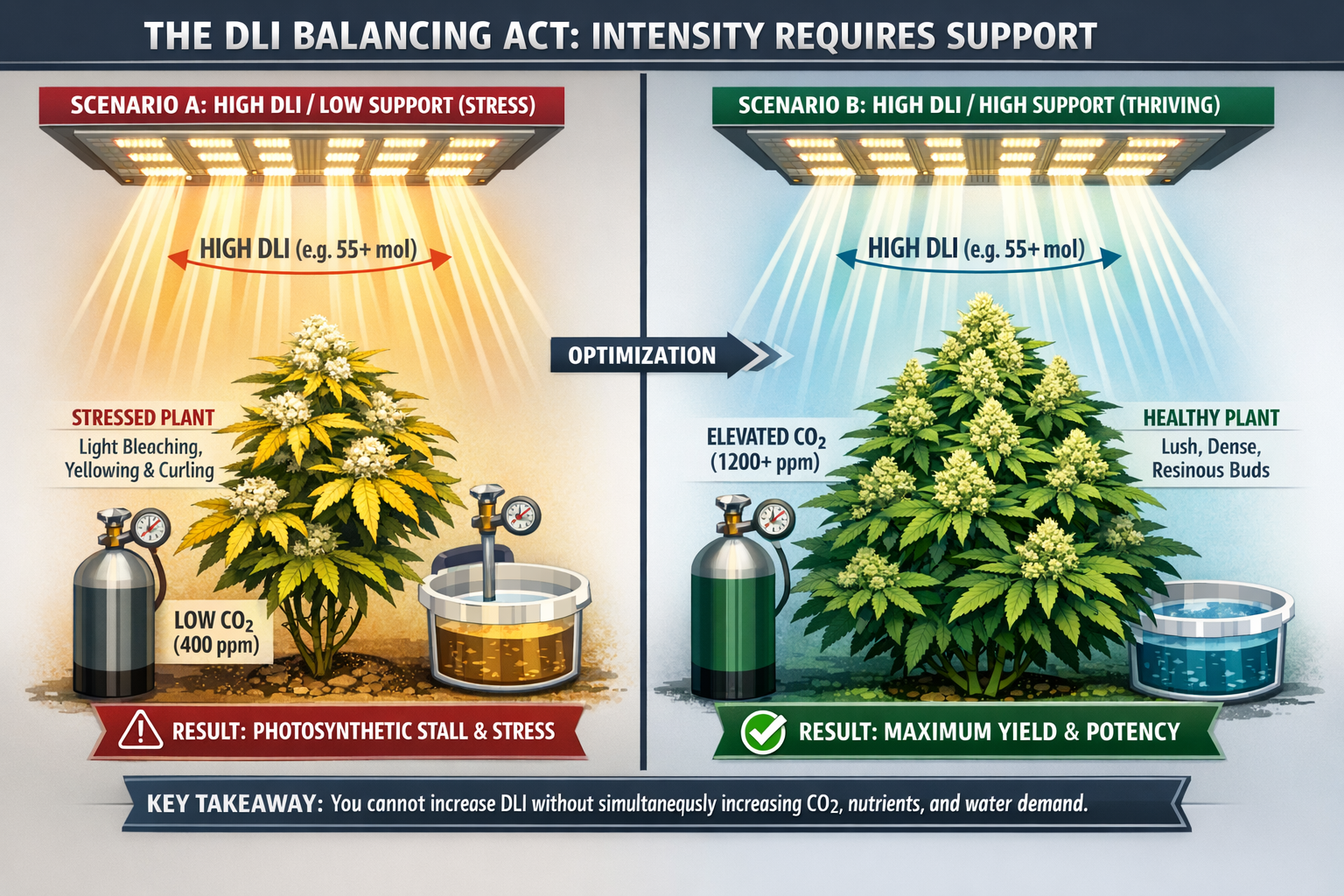
If you add CO₂ and Light but ignore the rest of the system, your plants will crash. Why? Because a turbocharged engine runs hotter and burns more fuel.
1. The Temperature Trap (Run it Hot)
CO₂ changes the physics of photosynthesis. In a CO₂-enriched environment, cannabis plants actually operate more efficiently at higher temperatures.
- Standard Room: 75–78°F.
- CO₂ Enriched Room: 82–85°F.
- The mistake: Keeping the room too cold slows down the enzymes, neutralizing the benefit of the CO₂.
2. The Nutrient “Stall”
When you successfully unlock high-speed photosynthesis, the plant’s metabolism skyrockets. It builds tissue faster, which means it drinks water and eats nutrients faster. A common pattern we see is “The Week 4 Stall”—plants look huge in Veg, then crash mid-flower. This isn’t “too much CO₂”; it’s a nutrient deficiency. The irrigation strategy couldn’t keep up with the turbocharged growth.
3. The Stomata Close-Up
High CO₂ levels can sometimes trick the plant’s stomata (pores) into partially closing. This reduces transpiration (the straw effect). To fix this, you often need to adjust your VPD (Vapor Pressure Deficit) to force the plant to keep drinking and transporting calcium.
The SUNSCAPE Performance Standard: Integrated Enrichment
At SUNSCAPE, CO₂ is never treated as a standalone setting. It is a Dependent Variable. We only deploy CO₂ enrichment after the Light Strategy, VPD, and Irrigation Rhythm are validated to handle the speed.
Ready to stop wasting gas and start amplifying yield?
Book a discovery call with SUNSCAPE to unlock the SUNSCAPE Performance Standard. Backed by 8 years of licensed cultivation data, we have established stage-specific CO₂, PPFD, and temperature operating ranges aligned to 63- to 73-day flowering cycles across more than 500 genetics.
Let us help you deploy CO₂ with precision—fully integrated with your lighting and environmental strategy—to consistently remove biological bottlenecks and unlock the true genetic potential of your crop.
References
Chandra, S., Lata, H., & ElSohly, M. A. (2017). Photosynthesis, transpiration, and water use efficiency in Cannabis sativa L. Advances in Botanical Research, 84, 117–140.
McAusland, L., Vialet-Chabrand, S., Davey, P., Baker, N. R., & Lawson, T. (2016). Effects of elevated CO₂ on stomatal dynamics and photosynthesis. Plant Physiology, 171(2), 1085–1098.
Zhen, S., Kusuma, P., & Bugbee, B. (2021). Toward an optimal spectrum for photosynthesis and plant morphology in LED-based crop cultivation. In Plant Factory: Basics, Applications and Advanced Research. Academic Press.
Pulse Grow, The Ultimate CO2 Guide for Indoor Growing