
In commercial cannabis cultivation, the difference between a “good” harvest and a “record-breaking” one often comes down to a single variable: Environmental Stability. At Sunscape, our iterative trialing of the “Old Fashioned Sunshine” (OFS) strain has provided a definitive case study on how Controlled Environmental Agriculture (CEA) infrastructure directly correlates to plant health and structural integrity.
By comparing Harvest 26-8 (our baseline) with the optimized Harvest 26-9, we have quantified the “Environmental Win” through hard data.
The Data: H26-8 vs. H26-9 Comparison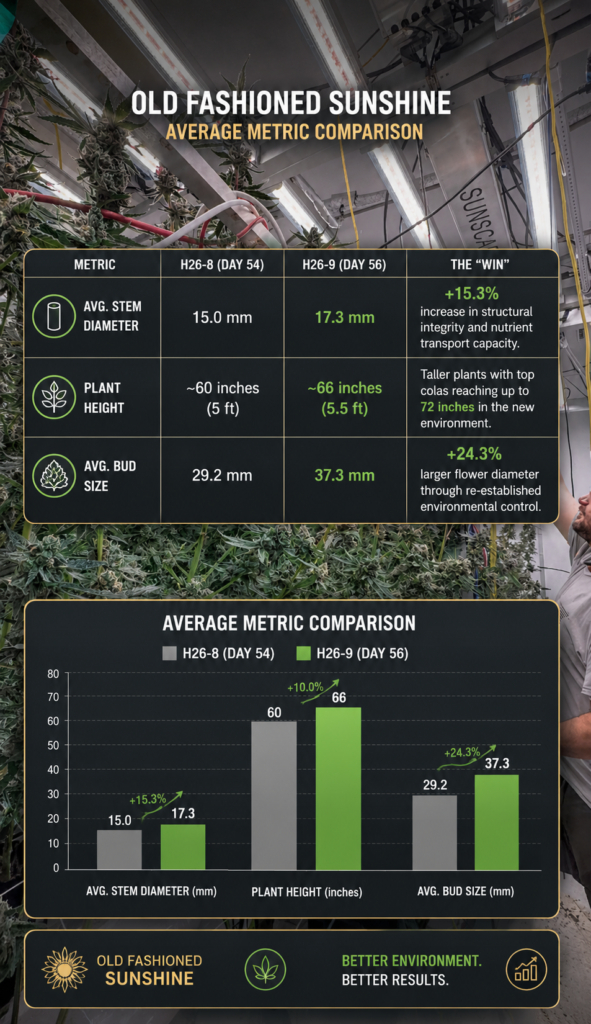
1. Re-establishing Environmental Control (HVAC Optimization)
The most significant driver behind the success of H26-9 was the installation of new HVAC infrastructure.
In H26-9, by re-establishing precise control over the heat load, we stabilized the Vapor Pressure Deficit (VPD).
2. Building the “Nutrient Highway”: Stem Thickness Gains
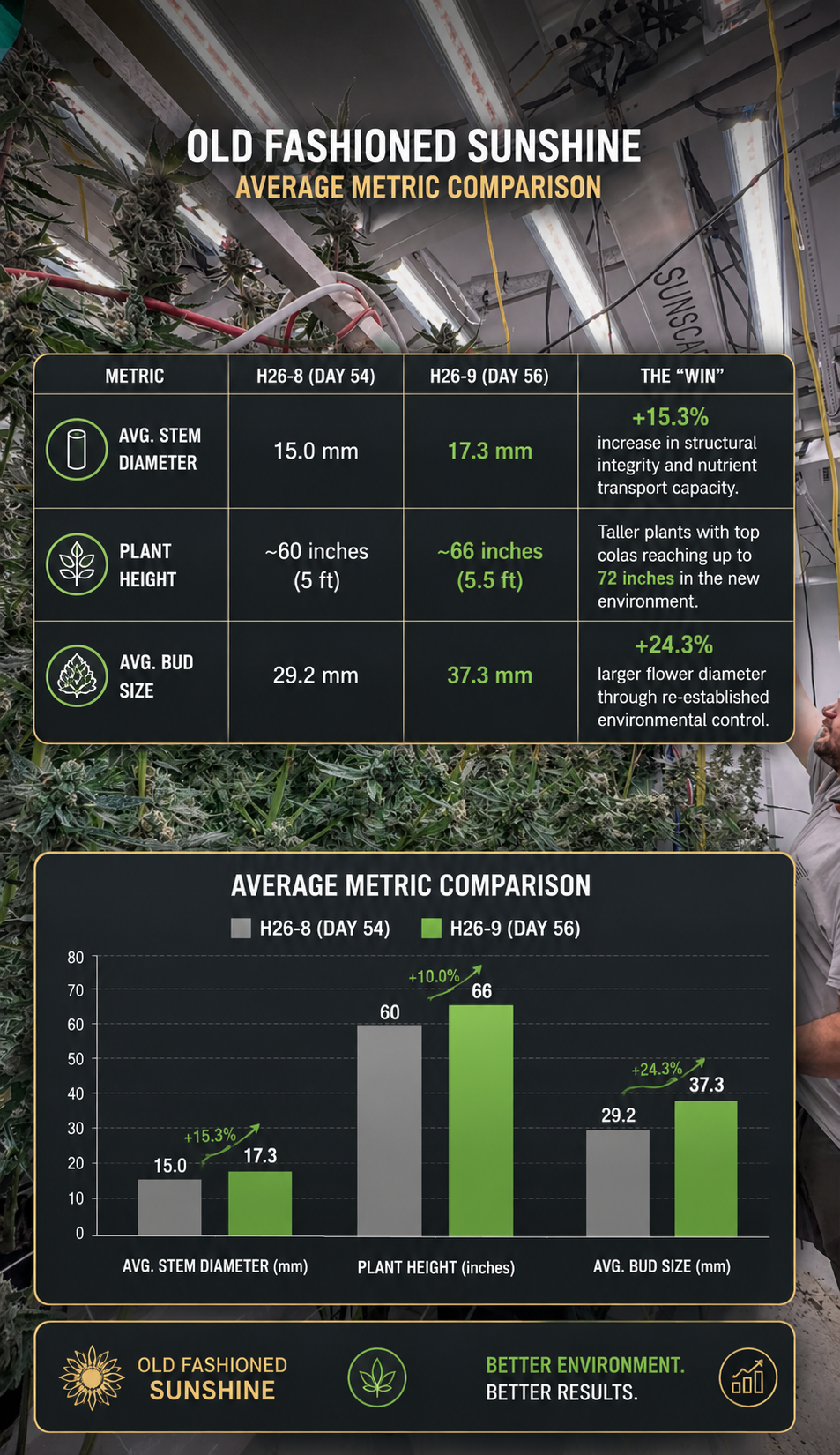
One of the most telling metrics of plant health is stem thickness. H26-9 saw a jump from a 15.0 mm average to 17.3 mm (with top performers reaching 18.8 mm).
-
Why it matters: A thicker stem acts as a superior “nutrient highway,” allowing for more efficient transport of water and minerals from the roots to the developing colas.
-
The Result: This structural foundation is what allowed H26-9 to support bud diameters averaging 37.3 mm, outperforming the baseline by nearly 28%.
3. Morphological Excellence: Tighter Stacking & Joined Colas
Beyond raw measurements, the morphology of H26-9 showed a marked improvement. Under the heat stress of H26-8, we observed “overstretched” colas with significant gaps between nodes.
By utilizing a combination of stable temperatures and targeted UBC lights to manage pressure, H26-9 achieved:
-
Tighter Internodal Spacing: Reduced “stretch gaps” led to more singular, joined colas.
-
A-Bud Quality: Solid, joined spears instead of spaced-out, “misformed” buds increase the commercial value of the final flower.
Conclusion: Data-Driven Iteration
The evolution from Harvest 26-8 to 26-9 proves that even with identical genetics, environmental precision is the ultimate yield driver.