
Precision Cultivation: Optimizing Pink Starburst through Data-Driven Trialing
In the world of commercial cannabis, the Pink Starburst strain is as rewarding as it is challenging. Known for its massive bud structures and relatively thin stems, this cultivar requires a specific “crop steering” touch. By analyzing four distinct harvest trials, we’ve uncovered a roadmap for optimizing this strain through precise irrigation strategies and EC management.
The Flowering Chronology: A Trial-by-Trial Comparison
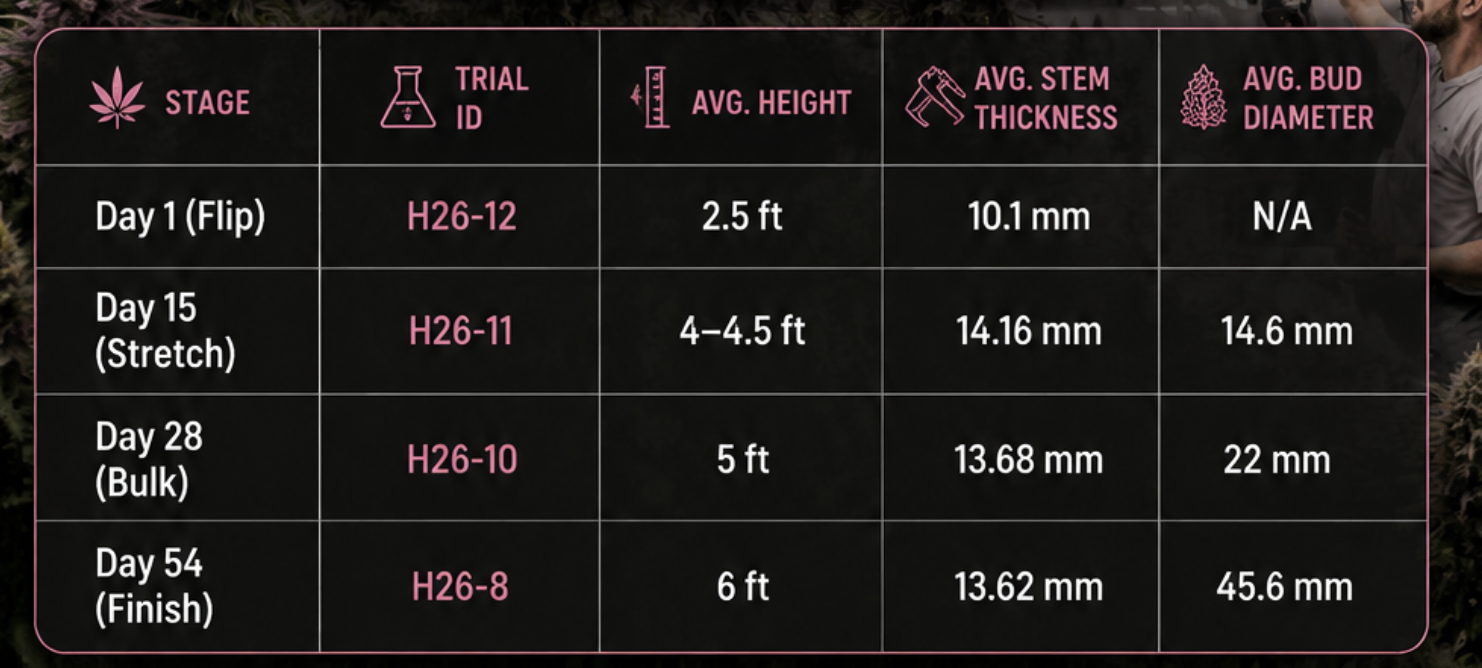
To understand how Pink Starburst performs, we measured physical growth metrics across the entire flowering cycle.
Early Flower: The EC Stacking Strategy
On Day 1, our primary goal is to “stack” the Electrical Conductivity (EC) in the pots quickly. We’ve observed in previous runs that EC changes can take weeks to become noticeable; therefore, we proactively raise these levels before the plant transitions into the biomass-heavy bulking phase.
Mid-Flower: The Irrigation Experiment
By Day 15, we enter the transition from stretching to bulking. In Harvest 26-11, we tested two distinct watering regimes to optimize nutrient uptake:
-
The 15-Minute Cooldown: Utilized on the right side of the room.
-
The 30-Minute Cooldown: Utilized on the left side
The Result: The side with the 30-minute cooldown showed a visually noticeable increase in EC accumulation. This data allows us to fine-tune shot sizes to ensure the media reaches field capacity at the right time of day.
The Bulking Phase: Managing the “Slow Feeder”
By Day 28 (Week 4), Pink Starburst is firmly in the bulking phase. We have identified this strain as a slow feeder, which naturally leads to rapid EC accumulation. In Harvest 26-10, EC stacked from under 2 to as high as 7.
To prevent osmotic pressure from becoming too high, we shifted to a “low dryback situation,” keeping the plants wet for longer while tapering the EC downward to flush excess salts.
Final Ripening & Environmental Challenges
As we approach Day 54, the plants are signaled to finish. We implement heavy drybacks and reduce light levels to ripen trichomes and bring out natural coloring.
However, trial H26-8 highlighted the importance of climate control. With AC units struggling to maintain temperatures (hitting 87°F), the canopy showed signs of heat stress, specifically curling leaf tips on the upper foliage. Despite this, the strain’s unique morphology held true: relatively thin 13.62 mm stems supporting massive 45.5 mm buds and 1.5-foot top spears.
Conclusion
Through these trials, it is clear that Pink Starburst thrives when EC is stacked aggressively early on and then carefully tapered during a low-dryback bulking phase. By monitoring stem thickness and bud swelling trial-by-trial, we continue to refine the blueprint for this high-yield cultivar.