
The Minnesota Crossroads: 2026 Gold Rush or Startup Graveyard?
Minnesota’s adult-use market is finally live, with a projected $430M+ [1] in revenue hitting by the end of the year. But for new license holders, the “Green Rush” comes with a warning: this pattern has played out before—and it always ends the same way.
We’ve analyzed a decade of data from Oregon, Colorado, and California. The outcome is identical every time—and Minnesota will not be different.
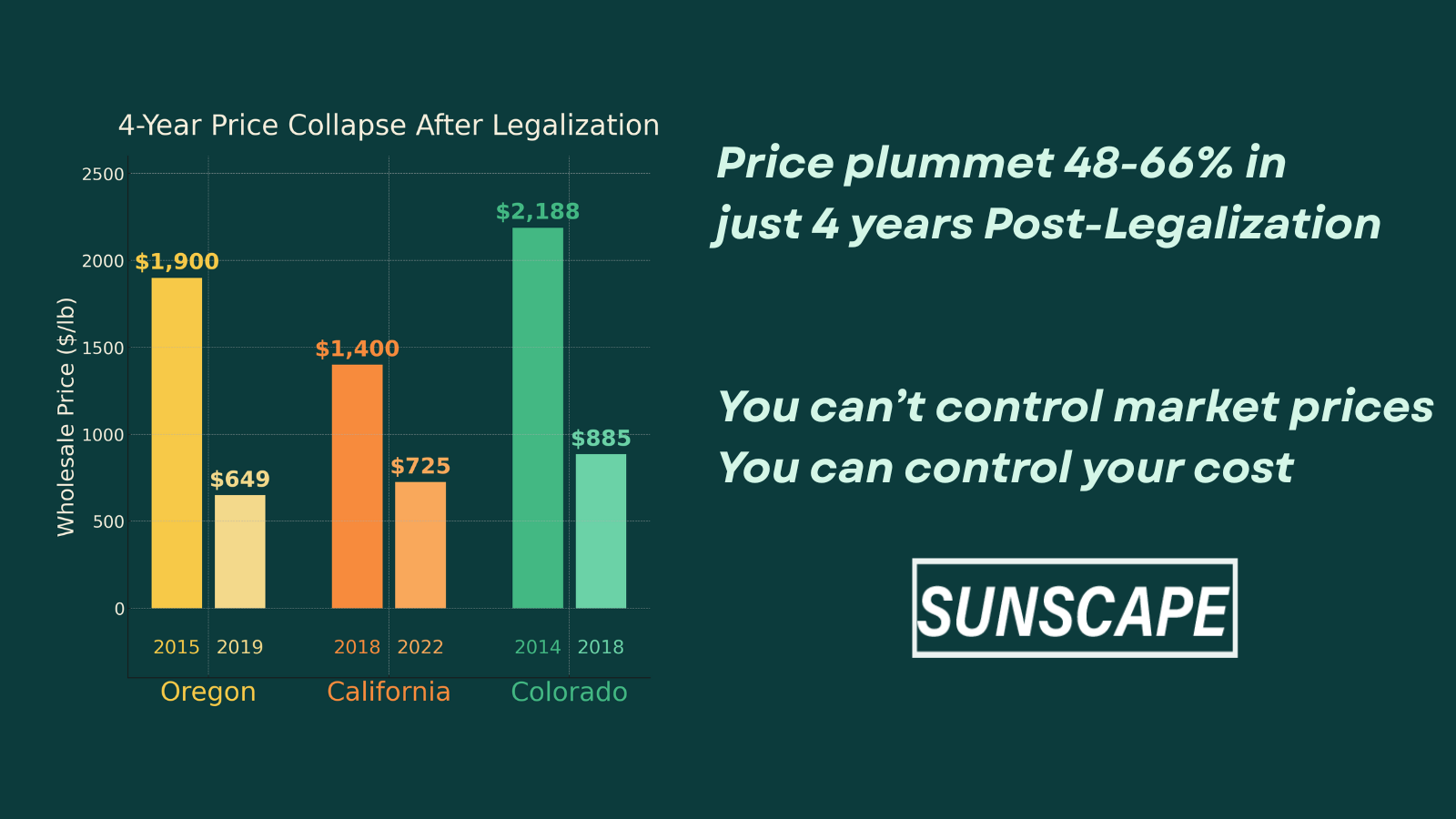
After legalization:
-
The 4-Year Price Cliff
Oregon: Crashed from $1,900 → $649/lb.
California: Dropped from $1,400 → $725/lb.
Colorado: Fell from $2,188 → $885/lb.
-
Inefficiency gets eliminated
Colorado lost 31% of commercial farms from 2021 to 2023 [2], and another 25% reduction in growers from 2023 to 2025 [3]
California now has more dead licenses (10,828) than active ones (8,514) [4]
Oregon medical growers collapsed from 46,000 → 2,961 in 2025 [5]
Price crashes don’t kill growers.
They kill facilities built for a market condition that no longer exists.
With startup costs reaching $450 per square foot [6], you cannot afford to overspend everywhere. You essentially have two ways to look at your facility design:
- The Standard Build: Following the traditional blueprint of buying separate components and brute-forcing the climate. While this is the industry norm, it often leads to higher upfront costs for oversized cooling and monthly bills that eat into your profit. Many startups spend their capital on hardware instead of control. Without precise environmental control, these expensive machines “fight” each other—the dehumidifiers heat the room while the AC tries to cool it. This invisible war generates inefficient electrical spikes and inflates your Operating Expense (OpEx) right when you need cash the most.
- The Integrated Build: This is the Oregon Roots blueprint. Instead of buying individual pieces of gear, you invest in an ecosystem where the lighting and climate system work together. This means designing lighting, climate, and controls as a single system—so heat, humidity, and energy use are managed proactively instead of reacted to. Intelligent design makes craft operators more competitive, more sustainable, and lowers startup costs.
By spending precisely where it unlocks Environmental Control, you do three things at once:
- Reduce your initial construction costs (CapEx)
- Slash your monthly overhead (OpEx)
- Ensure your product has that undeniable, top-shelf quality
Case Study: Oregon Roots
Jathan, CEO of Oregon Roots, isn’t a “tech bro.” He is a legacy grower who helped provide medicine to Vietnam veterans long before the market went recreational. He was “Licensed #11” in Oregon—a pioneer who spent two decades under the orange glow of High-Pressure Sodium (HPS) bulbs.
The Before: Fighting the Room
For 20 years, Jathan’s life was a battle against environmental swings. His growers were “Room Janitors,” consumed by the daily struggles of rooms getting too hot, too cold, or too humid.
- The Risk: An HPS bulb exploded, caught fire, and burned down an entire room.
- The Guesswork Cost: Growers were stuck checking old wall thermometers and guessing what to do next
The After: The Power of an Integrated Brain
When Jathon switched to SUNSCAPE Intelligent Design, he didn’t just get new lights; he got an automated controlled agriculture environment for cannabis;
- Stop Guessing, Start Growing: Jathon transitioned to a fully automated system. Instead of manual adjustments, he now “punches in” his target Vapor Pressure Deficit (VPD), and the SUNSCAPE R2D3 controller manages the lighting, AC, and dehumidification in total lockstep.
- The Thermal Edge: By prioritizing the right light spectrum matching the 12 week grow cycle of the plant —Jathan found he could reduce the load on his AC units when he needed the most: at the finish. This is the secret to Slashing OpEx: when the lights work to meet the priority of the plant, monthly energy cost gets reduced and your yield and quality increases.
- Undeniable Quality: Jathan noted that across 10 different strains, the results were “night and day” compared to HPS. He saw trichomes swelling beautifully and achieved a level of bag appeal that ensures his product stands out on the top shelf.
Jathan survived the Oregon Price Crash because he stopped fighting his equipment and started using it to unlock profit. For a Minnesota startup, Jathan’s story is a blueprint: Don’t build a facility for today’s high prices; build it to be the most efficient operator in the market, build it so you can produce top shelf with the lowest cost possible.
The Minnesota Blueprint:
Minimizing Electrical and Heat Load, Maximizing Yield
In a market where building costs can hit $450 per square foot, your facility must be a profit engine, not a cost center. To survive the inevitable price compression, you need two things:
Minimizing Electrical and Heat Load
In a standard facility, the lighting, dehumidifiers and AC systems are often in a state of “equipment war.” SUNSCAPE ends this war through three specific technological advantages:
- 94.5% Fixture Efficiency: Standard LED fixtures waste 15–20% of their energy through inefficient drivers and thermal loss. SUNSCAPE LED lights operate at up to 94.5% efficiency and up to 3.1 µmol/J PPE, ensuring almost every watt you pay for is converted into photons, not wasted ambient heat. By keeping the heat out of the fixture, we drastically lower the initial heat load your facility has to manage.
- Revolutionary Water-Cooled HVAC: Tested in the SUNSCAPE R&D Center, our upcoming water-cooling system has demonstrated a 40% to 60% reduction in electrical load compared to regular AC climate control.
- Customizable Dimming: Our dimming system allows you to mimic the natural sun’s arc and adjust intensity based on the plant’s metabolic stage. SUNSCAPE’s system provides independent channel control for Blue, Red, and Orange spectrums, allowing for a level of precision that standard “On/Off” growers can’t match.This precision control provides an additional 20% savings on your lighting OpEx with zero yield loss.
Maximizing Yield
We track our data to ensure that low cost never means low quality. Our recent StarFruit harvest provides the mathematical proof of what an optimized facility can achieve, without the use of synthetic Plant Growth Regulators (PGRs):
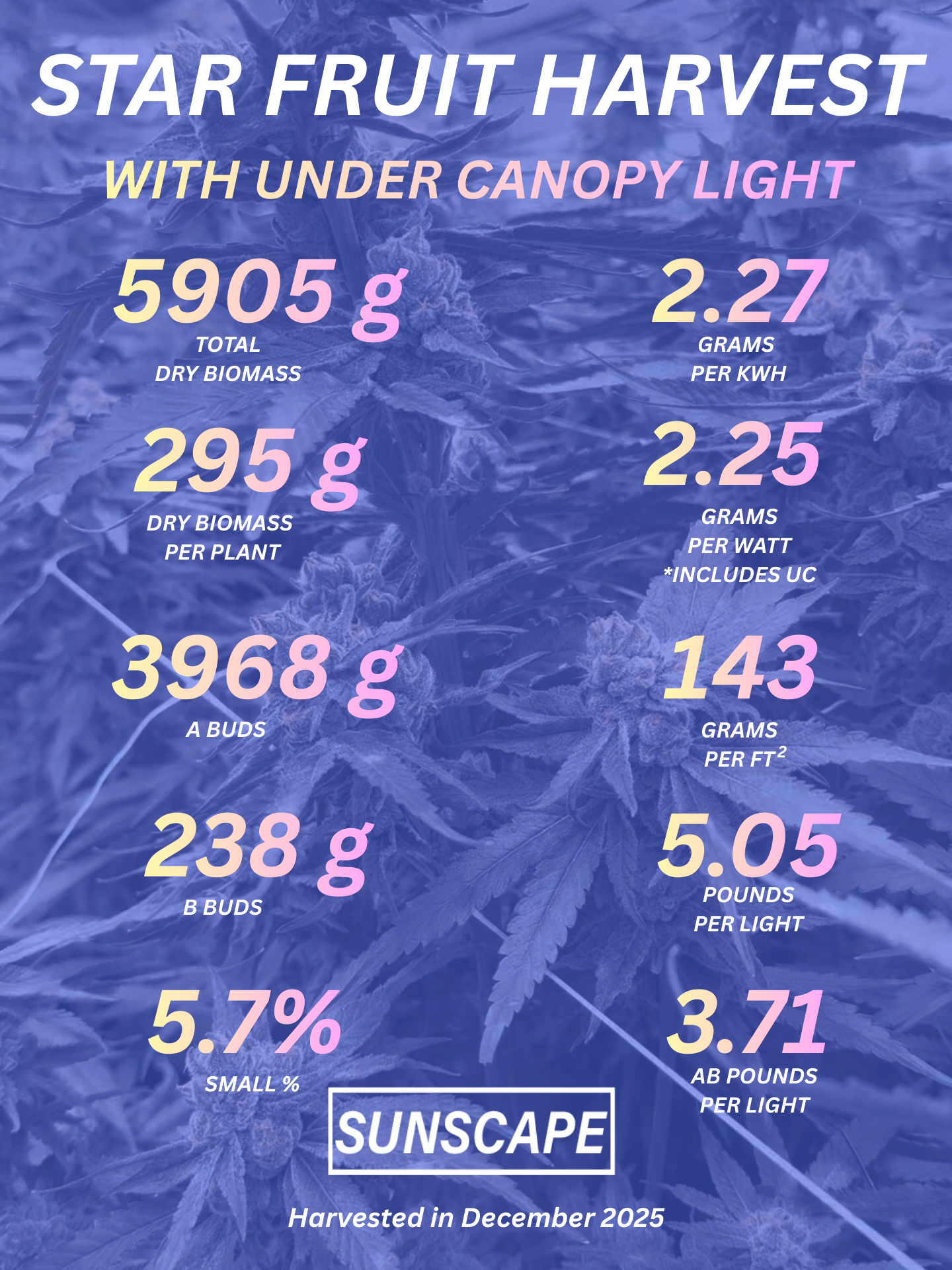
By using SUNSCAPE Under-Canopy Lighting, we activate the bottom of the plant that most growers simply throw away as larf. This turns what used to be waste into high-value A-grade flower, ensuring that every watt of electricity you pay for is converted into sellable medicine.
Build for the Price Floor, Not the Ceiling
If you are currently reviewing blueprints or preparing to pour concrete, the most expensive mistake you can make is building a legacy-style facility for a maturing market. Don’t let your project become a “dead license” statistic because your OpEx was too high to survive the price floor.
Unlock SUNSCAPE Intelligent Design and transition from “Room Janitor” to high-efficiency operator. Backed by 8 years of data collection, we have established precise baselines matching the 63 to 73-day flowering cycles of over 500 unique genetics.
- PPFD&DLI Matching: We align light intensity mathematically with your plant’s metabolic capacity to maximize yield without light stress.
- Spectrum Tuning: Precision-tune your light recipes to activate secondary metabolites, producing elite terpene and cannabinoid profiles that synthetic PGRs can’t touch.
- Environmental & VPD Sync: We harmonize your lighting with Vapor Pressure Deficit (VPD) to ensure optimal transpiration and nutrient uptake.
- Integrated Irrigation Strategy: Align your Dry Backs and salt management (EC) with your lighting cycles to master Crop Steering and drive generative growth.